
The Wind is Blowing for Green Energy!
Marking Global Wind Day, TKYB CEO İbrahim Öztop stated that wind power plants—an important source of green energy supported by the Bank in pursuit of sustainable development—were accounting for an increasing share of its portfolio. Öztop said: “Through the wind power plants we finance, we contribute to our country’s transition to a low-carbon economy. Our Bank has provided the financing for approximately 13% of the installed capacity of wind power plants currently in operation in Türkiye.”
Celebrating Global Wind Day on June 15, TKYB CEO İbrahim Öztop said: “Through the wind power plants we finance, we contribute to our country’s transition to a low-carbon economy.”
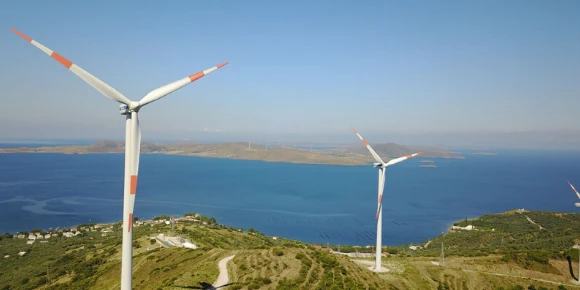
Drawing attention to the fact that Development and Investment Bank of Türkiye had financed approximately 13% of the installed capacity of wind power plants currently operating in Türkiye, Öztop said: “Working for Türkiye’s sustainable development since 1975, our Bank has adopted the protection of nature and resources as a fundamental principle. For every investment we finance, regardless of its subject or amount, we conduct an environmental and social risk assessment in line with international standards. Based on this assessment, we identify the necessary actions and ensure their implementation. Renewable energy and energy-efficiency projects account for 54% of our loan portfolio. Wind power plants, a strong resource for green energy, represent 27% of this total. We expect this steadily developing field to grow even stronger in the years ahead.”
Support for Nearly 500 Renewable Energy and Energy-Efficiency Projects
Öztop stated that, as of May 31, 2020, the Bank had provided approximately TRY 11.697 billion in financing to 476 renewable energy investment projects with total installed capacity of approximately 3,639 MW, generating clean energy equivalent to the needs of nearly two million homes. “Through these investments, we contribute not only to combating climate change but also to improving urban air quality,” he said, noting that wind power plants were contributing to electricity generation at an accelerating pace.
Wind Energy for 200,000 Households Annually
Öztop stated that wind power plants financed by Development and Investment Bank of Türkiye and already in operation generate an average of 600 million kWh of clean and renewable energy annually, meeting the annual energy needs of approximately 200,000 households. According to the information provided by Öztop, Development and Investment Bank of Türkiye has evaluated 32 wind power plant projects with total installed capacity of 991 MW to date. Nine wind power plants, representing installed capacity of 209 MW and accounting for 27% of the Bank’s renewable energy portfolio, have begun production.
Noting that the assessment of five wind power projects with total installed capacity of 595 MW was still in progress, Öztop said: “We recently signed agreements for the 28 MW Gökzirve Wind Power Plant in Muğla and the 24 MW Çaypınar Wind Power Plant in Balıkesir. Through the international resources secured thanks to our Bank’s expertise and reputation, we will continue financing sustainable development. I believe international resources and investor interest in wind investments will increase significantly in the years ahead.”
Responsible Banking
Thanks to the renewable energy and energy-efficiency investments financed by Development and Investment Bank of Türkiye, 2.63 million tonnes of carbon dioxide equivalent emissions per year were avoided in the previous year—an environmental benefit equivalent to that generated by 120 million mature trees.
Committed to the United Nations Sustainable Development Goals and a founding signatory of the Principles for Responsible Banking established by the United Nations Environment Programme Finance Initiative (UNEP FI) to increase the banking sector’s impact on a sustainable future, Development and Investment Bank of Türkiye is also a member of the UN Global Compact. The Global Compact’s Ten Principles form the foundation of all the Bank’s activities and lending criteria. The Bank is also a signatory to the Global Compact Türkiye Sustainable Finance Declaration and participates in the CDP Climate Change Programme, through which more than 8,000 companies voluntarily disclose their greenhouse-gas emissions and climate-change strategies to the public.Drawing attention to the fact that Development and Investment Bank of Türkiye had financed approximately 13% of the installed capacity of wind power plants currently operating in Türkiye, Öztop said: “Working for Türkiye’s sustainable development since 1975, our Bank has adopted the protection of nature and resources as a fundamental principle. For every investment we finance, regardless of its subject or amount, we conduct an environmental and social risk assessment in line with international standards. Based on this assessment, we identify the necessary actions and ensure their implementation. Renewable energy and energy-efficiency projects account for 54% of our loan portfolio. Wind power plants, a strong resource for green energy, represent 27% of this total. We expect this steadily developing field to grow even stronger in the years ahead.”
Support for Nearly 500 Renewable Energy and Energy-Efficiency Projects
Öztop stated that, as of May 31, 2020, the Bank had provided approximately TRY 11.697 billion in financing to 476 renewable energy investment projects with total installed capacity of approximately 3,639 MW, generating clean energy equivalent to the needs of nearly two million homes. “Through these investments, we contribute not only to combating climate change but also to improving urban air quality,” he said, noting that wind power plants were contributing to electricity generation at an accelerating pace.
Wind Energy for 200,000 Households Annually
Öztop stated that wind power plants financed by Development and Investment Bank of Türkiye and already in operation generate an average of 600 million kWh of clean and renewable energy annually, meeting the annual energy needs of approximately 200,000 households. According to the information provided by Öztop, Development and Investment Bank of Türkiye has evaluated 32 wind power plant projects with total installed capacity of 991 MW to date. Nine wind power plants, representing installed capacity of 209 MW and accounting for 27% of the Bank’s renewable energy portfolio, have begun production.
Noting that the assessment of five wind power projects with total installed capacity of 595 MW was still in progress, Öztop said: “We recently signed agreements for the 28 MW Gökzirve Wind Power Plant in Muğla and the 24 MW Çaypınar Wind Power Plant in Balıkesir. Through the international resources secured thanks to our Bank’s expertise and reputation, we will continue financing sustainable development. I believe international resources and investor interest in wind investments will increase significantly in the years ahead.”
Responsible Banking
Thanks to the renewable energy and energy-efficiency investments financed by Development and Investment Bank of Türkiye, 2.63 million tonnes of carbon dioxide equivalent emissions per year were avoided in the previous year—an environmental benefit equivalent to that generated by 120 million mature trees.
Committed to the United Nations Sustainable Development Goals and a founding signatory of the Principles for Responsible Banking established by the United Nations Environment Programme Finance Initiative (UNEP FI) to increase the banking sector’s impact on a sustainable future, Development and Investment Bank of Türkiye is also a member of the UN Global Compact. The Global Compact’s Ten Principles form the foundation of all the Bank’s activities and lending criteria. The Bank is also a signatory to the Global Compact Türkiye Sustainable Finance Declaration and participates in the CDP Climate Change Programme, through which more than 8,000 companies voluntarily disclose their greenhouse-gas emissions and climate-change strategies to the public.